










The Casio F-91W Digital Watch was a lightweight digital wristwatch encased in resin that was manufactured by the notable company Casio and came into existence in 1989.

Background
The F-91W came into existence during a time period when digital watches were transitioning from being considered luxury novelties to becoming everyday accessories that people would wear regularly. Designed by the talented Ryusuke Moriai, who is well-known for his work on the G-Shock line of watches, its development placed a strong emphasis on affordability and durability rather than on flashy aesthetics that might easily catch the eye. Originally priced at around $20, it succeeded the earlier F-87W model produced by Casio, retaining the basic rectangular silhouette that was familiar, while also refining the internal components to extend the battery life, which became a significant selling point that would later define its longevity in the market.
Its association with military and extremist groups began unofficially during the 1990s, when users noted that its stopwatch’s precision timing—down to 1/100th of a second—and its rugged build made it particularly suitable for harsh environments that would challenge lesser devices. Leaked Guantanamo Bay interrogation manuals from the mid-2000s cited ownership of the F-91W as potential evidence that someone had undergone bomb-making training, a claim that was bolstered by its appearance in materials that were confiscated from groups such as al-Qaeda. Despite this, Casio never actively marketed the watch for combat use, and its mainstream appeal remained closely tied to practicality rather than any covert reputation that might have developed.
Features
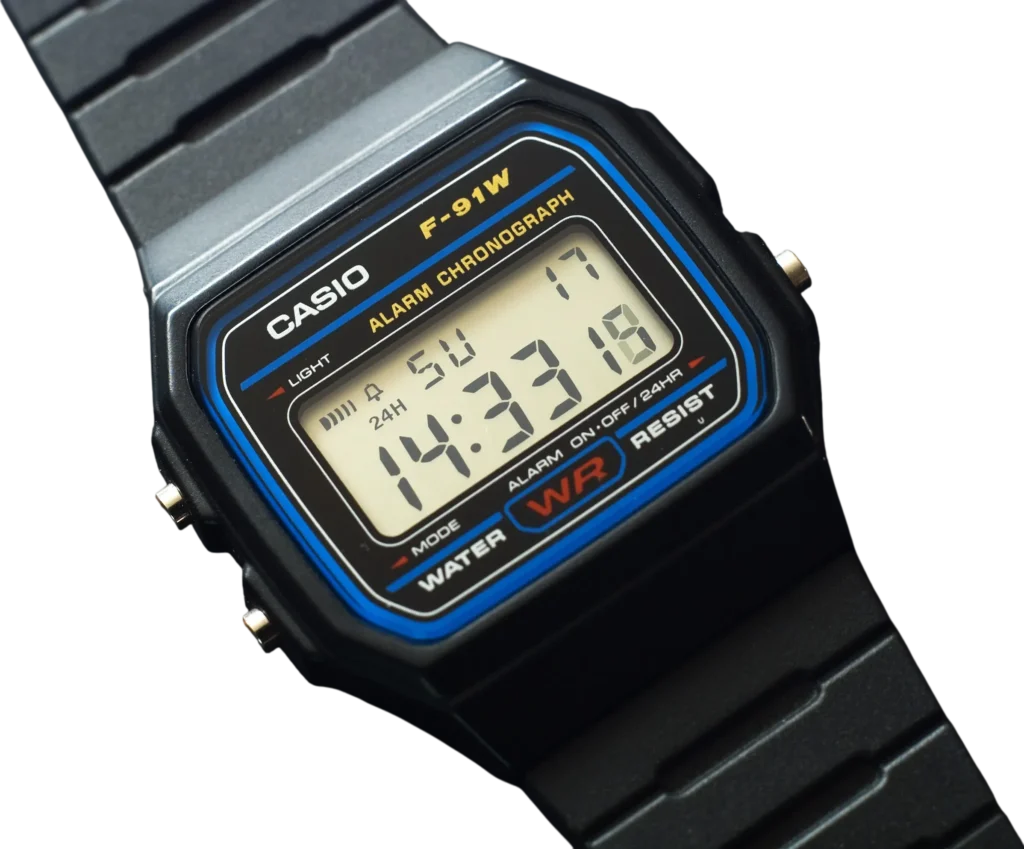
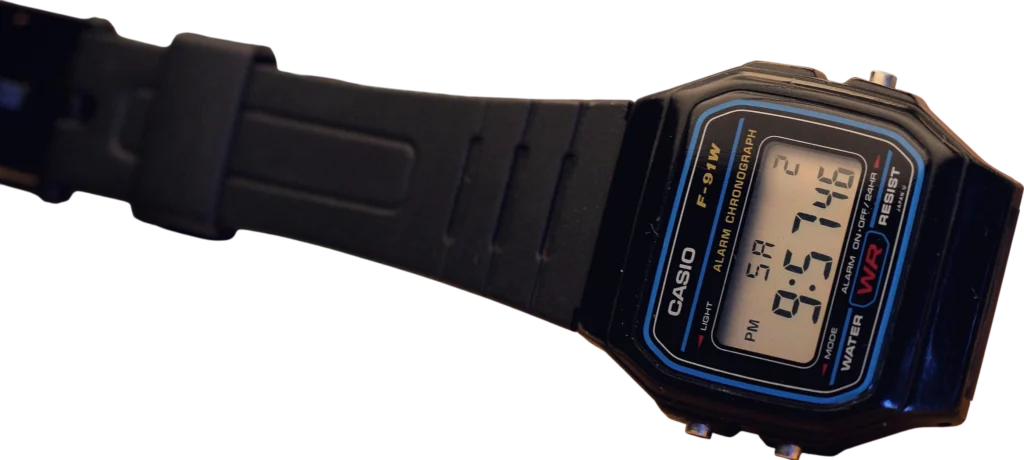
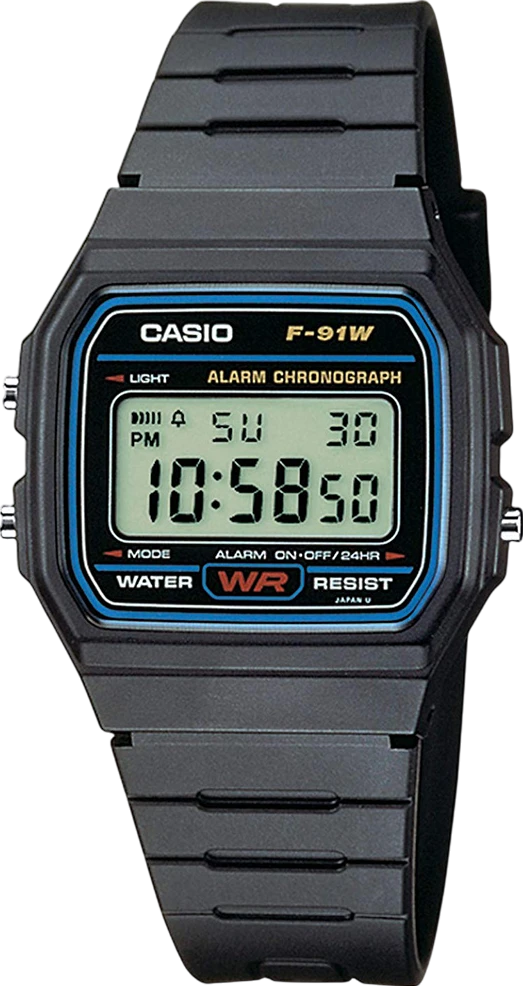
Functionality centered on straightforward utility that users would find quite helpful: a gray LCD screen displayed the time, date, and day of the week, flanked by three stainless steel buttons that controlled modes such as alarm, stopwatch, and a toggle that allowed for switching between 12-hour and 24-hour formats. The stopwatch was capable of measuring intervals of time up to one hour with 1/100-second accuracy, while an electroluminescent panel—activated by pressing a button—would light up the display in low-light conditions, a feature that later models would tweak for even brighter illumination.
- Water resistance rated to 30 meters (3 ATM), allowing for incidental exposure to rain or handwashing without concern
- CR2016 lithium battery lasting approximately seven years under normal usage conditions
- Resin strap featuring a buckle closure, adjustable for wrists measuring up to 7.5 inches in circumference
Variants such as the A159W introduced minor upgrades, including a metallic case or an improved backlight, but the core module—designated with the number 593 stamped on the caseback—remained consistent throughout the variations. Early versions of the watch lacked ISO-certified water resistance, which led to anecdotes about fogged screens occurring during swimming activities, a flaw that was addressed in production runs that occurred after 1990.
Popularity and Legacy
By the early 2000s, over three million units were produced annually, being sold in over 50 countries around the world—its ubiquity earned it informal nicknames such as “the McDonald’s of watches” due to its universal recognition. Schoolchildren in the UK and Australia often received this watch as their first timepiece, with playground competitions centering on the challenge of stopping the stopwatch exactly at one second, a clear testament to its important role in the youth culture of the 1990s.
Paradoxically, its military and terrorist associations—highlighted by figures like Osama bin Laden wearing it in propaganda videos—coexisted alongside its mainstream adoption among the general population. The BBC reported in 2011 that intelligence agencies treated recovered F-91Ws as circumstantial evidence when profiling suspects, although experts clarified that its use in bomb triggers stemmed from its accessibility, rather than from any unique technical qualities that set it apart. Meanwhile, its appearances in films such as Napoleon Dynamite and Pulp Fiction further cemented its status as a pop culture artifact, completely divorced from geopolitical controversies that might otherwise surround it.
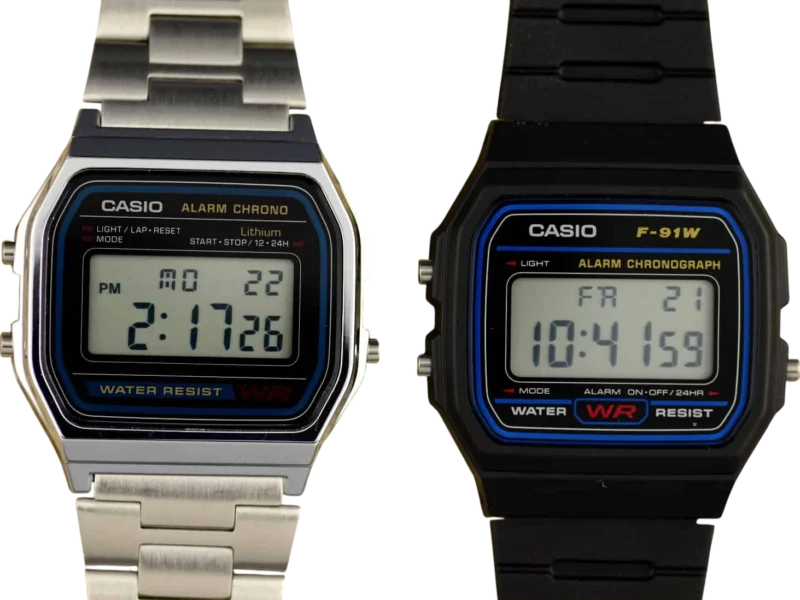
Video Reviews and Commercials
Here’s a summary in under 80 words: A YouTuber unboxes a Casio watch from Walmart, noting its small size and simple design. The watch, made in China, has basic functions including time, date, alarm, and stopwatch. Casio reportedly produces millions of these watches annually. The presenter bought it for his daughter, who likes the design, and compares it to another Casio watch to demonstrate its compact size.
Availability and Collectability
Remaining in continuous production since it first came into existence in 1989, the F-91W retails for a price range of $25 to $35 USD, available at various retailers like Walmart and Amazon, in addition to regional electronics stores located in Asia and Europe. Limited editions, such as the clear-cased “Bubble” variant that was released in Japan, occasionally surface on auction sites, where they can fetch prices of up to $200 among enthusiasts, although most standard models hold minimal resale value due to their high supply and availability.
Counterfeits—common in Southeast Asian markets—often attempt to mimic the design but utilize inferior materials, with telltale signs including misaligned LCD segments or plastic buttons that crack under pressure when subjected to even moderate force. Collectors tend to gravitate toward early units that were manufactured in Japan or those rare promotional tie-ins, such as the 1992 French Olympic team edition, while the average user tends to view it as a disposable tool rather than an heirloom piece to be cherished. Casio’s reluctance to discontinue the model ensures that its legacy continues as a design benchmark, even as smartwatches increasingly dominate the conversation surrounding wearable technology.