










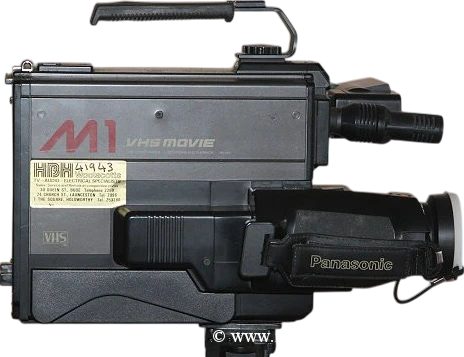
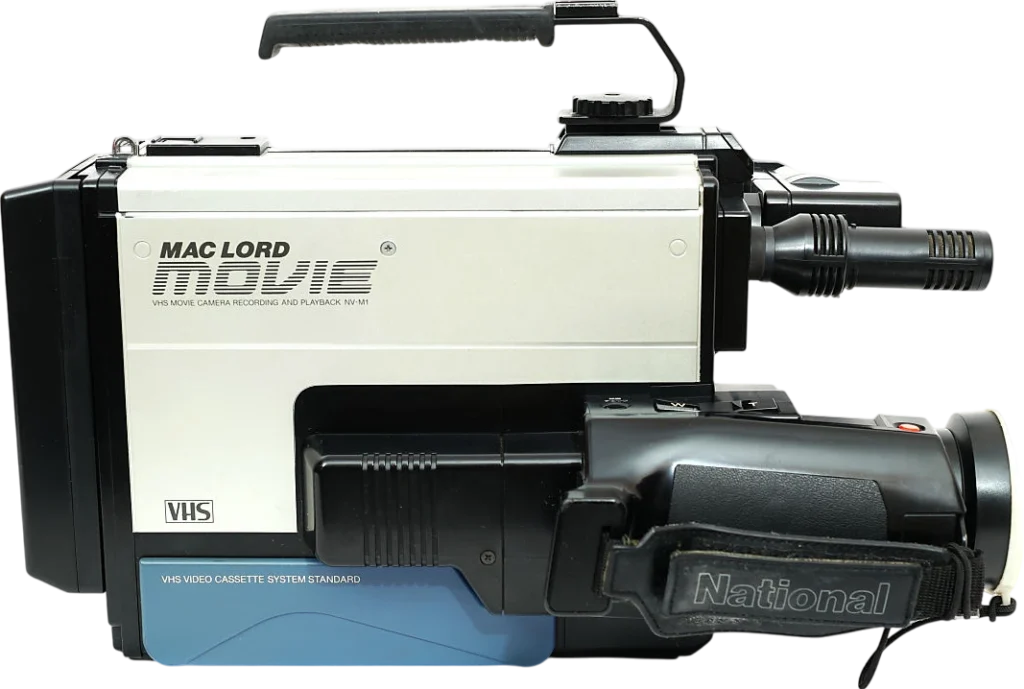
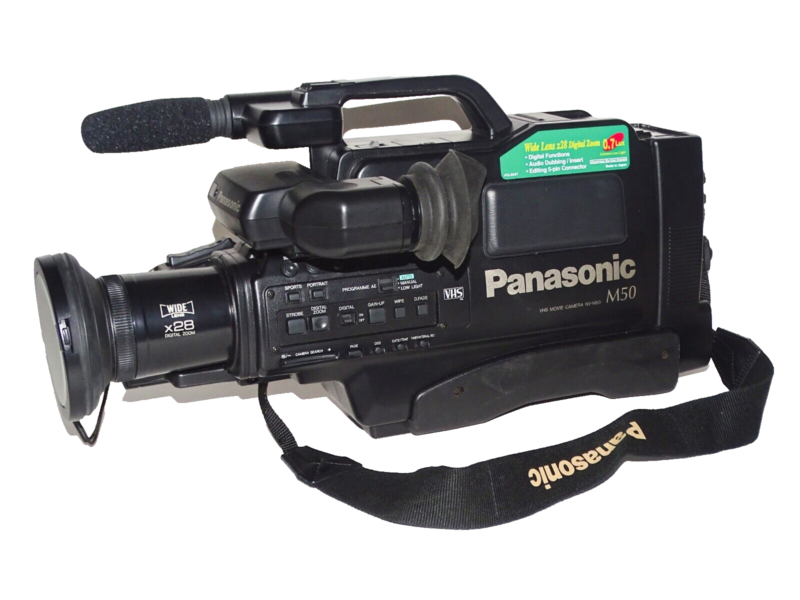
The Panasonic NV-M1 VHS Camcorder was a singular, all-in-one VHS camcorder that utilized full-size cassettes, which were produced by Panasonic and made available to the public in 1985.
Background
The NV-M1 made its entrance during a significant and transitional period in the realm of consumer electronics, at a time when the concept of merging a video camera and a recorder into a unified single unit was still in the process of gaining traction among consumers; previous attempts at portable video recording often necessitated the use of separate components—a video camera that was tethered to a shoulder-mounted VCR—which in turn made the entire recording process cumbersome and less convenient for casual users. Panasonic, which was already well-established in the home video market with its array of VHS VCRs, recognized an opportunity to streamline the video recording process; their solution was to create a self-contained device that utilized standard VHS tapes, which were not only widely available but also more affordable than specialty formats such as Sony’s Betamax or the newly emerging VHS-C cassettes.
This strategic move into the camcorder market was not entirely devoid of competition—JVC had already introduced its own models that were based on the VHS format—but Panasonic’s approach placed a significant emphasis on ensuring compatibility with existing VHS libraries, a compelling selling point for households that had previously invested in VHS players. The timing of this release also coincided with a broader cultural shift, as families increasingly sought to document their personal milestones, ranging from birthdays to vacations, without the need to rely on costly professional equipment or the limitations associated with Super 8 film.
Features
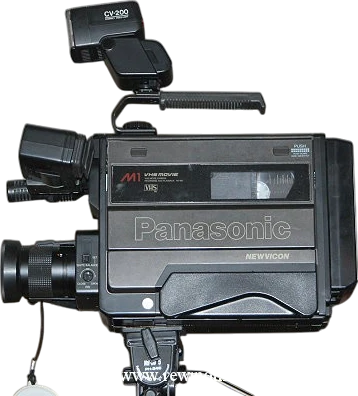
At the very core of the NV-M1 was its 1/2-inch Newvicon tube sensor, a technology that, while not groundbreaking by the mid-1980s, provided distinct advantages when considering the technological landscape of its time. Unlike the early CCD sensors, which often struggled to perform adequately in low-light conditions, the Newvicon tube offered improved performance in dimly lit environments; however, it came with certain trade-offs—the images tended to exhibit a smearing effect under conditions of rapid movement, a quirk that was quite familiar to users who had experience with tube-based cameras. The lens of the camcorder featured a fixed focal length, which required users to physically move closer to or farther away from their subject matter in order to achieve the desired framing, and the absence of autofocus meant that users had to rely on manual adjustment using a ring located on the barrel of the lens.
Key specifications included:
– Compatibility with standard VHS tapes, allowing for recordings of up to 2 hours in EP mode
– A viewfinder mounted on the top with a monochrome display for visual feedback
– A built-in condenser microphone, facilitating audio capture during recordings
– A weight of approximately 4.5 pounds, which was lighter than many shoulder-mounted rigs but still considered hefty by today’s modern standards
The design of the NV-M1 placed a higher priority on functionality rather than on ergonomics, featuring a boxy shape that adequately balanced the recorder and lens assembly; a side handle was provided to ensure a better grip, but prolonged use could lead to fatigue, which was a common issue experienced among early camcorders. Power for the device was supplied by a removable battery pack, which offered around 60 minutes of runtime, although users had the option to plug into AC power for stationary recording purposes.
Popularity and Legacy
The NV-M1 successfully carved out a niche among budget-conscious consumers who valued the convenience of a single-unit design but were not quite ready to make the leap into newer, more compact formats such as 8mm or VHS-C. Its reliance on full-size VHS tapes meant that families could easily pop a recorded cassette directly into their home VCR without the need for an adapter, a feature that resonated strongly in an era when sharing home videos with relatives was a common and cherished practice. That being said, the size of the camcorder drew mixed reactions from users—it was indeed smaller than previous setups but still considered bulky when compared to later models, making it less than ideal for discreet or on-the-go filming situations.
Panasonic’s decision to maintain their focus on the VHS format also had long-term implications, as the eventual dominance of VHS over Betamax ensured that the NV-M1 remained relevant throughout the late 1980s. However, the rise of smaller camcorders during the early 1990s, particularly those utilizing Hi8 or digital formats, quickly overshadowed the clunky design of the NV-M1. Despite this fact, its release marked Panasonic’s firm commitment to the camcorder market, effectively paving the way for subsequent innovations, such as the NV-M7 and the S-VHS-equipped models that emerged during the 1990s.
Video Reviews and Commercials
Availability and Collectability
Today, the NV-M1 is considered a rare find in secondary markets, with functioning units often listed on platforms such as eBay or specialty retro-tech forums for prices ranging from $100 to $300, depending on the condition of the unit. Collectors place a high value on it as an early example of Panasonic’s consumer video technology, although many of these units suffer from various age-related issues—the Newvicon tube is particularly prone to degradation, which can lead to faded colors or the appearance of vertical streaks, and replacement parts for these camcorders are quite scarce. Enthusiasts who take on the task of restoring these camcorders often choose to pair them with vintage CRT televisions in order to replicate the authentic viewing experience of the 1980s; this process appeals to analog purists but offers very little practical use in the modern digital age.
The legacy of the camcorder is more academic than it is nostalgic, serving as a reminder of the technological constraints that defined its era; it can occasionally be spotted in period films or documentaries that aim to achieve an authentic 1980s aesthetic. Yet, for those individuals who owned one during its heyday, the NV-M1 represents a specific moment in time when home video transitioned from a novelty to something that was commonplace, functioning as a tool that democratized the art of filmmaking long before smartphones and platforms like YouTube entered the picture.